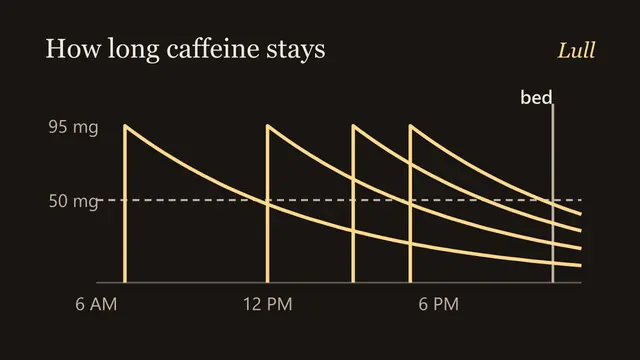
How long caffeine stays in your system
What one coffee at 7 AM, noon, 3 or 5 PM leaves at bedtime.
Page updated
Pick the time you need to be up.
Late already? You still get wake-up times to pick from, with any short night labeled.
Up at 6:30 AM? An adult's suggested bedtime is 10:45 PM. That leaves room for 5 sleep cycles of 90 minutes and 15 minutes to fall asleep.

There’s no perfect night, only a better-planned one.
The Lull app has the same bedtime calculator, plus 6 sleep sounds that stop a minute before your phone’s alarm.
See the Lull appThe calculator uses one cycle length for everyone. The NHLBI gives a range of 80 to 100 minutes, and cycles also vary from one night to the next, so a time that ends exactly on a cycle for the arithmetic may not do so for you. It cannot know how long you take to fall asleep, whether you wake during the night, or how much sleep you personally need. The age ranges are the CDC's recommendations for groups, not a measure of one person.
See a doctor if you regularly take more than 30 minutes to fall asleep, which NIOSH lists among the symptoms to raise with a health care provider, or if you still feel tired after enough sleep. For a child or teen, ask the child's doctor about ongoing trouble settling or loud snoring. This page is general information, not medical advice: read our disclaimer.

Lull turns public sleep research into a bedtime to aim for, and shows every source below.
Sleep runs in repeating cycles of lighter sleep, deep sleep and REM sleep. For naps, NIOSH's training for nurses says that waking at about 90 minutes, the predicted end of a sleep cycle, may leave less grogginess, because you are likely to wake from lighter sleep. The calculator applies that idea to a night's sleep: ending on a whole cycle is our planning method, not a published rule for the night. It counts whole cycles of 90 minutes back from the time you need to wake up, or forward from the time you go to bed, and adds 15 minutes for falling asleep. Both figures are studio rules, and the table further down says where each one comes from.
The age group only changes how many cycles the calculator suggests. It picks the fewest whole cycles that give more than the bottom of the CDC's recommended range for that group, then shows 1 option with fewer cycles and up to 2 with more. Options outside the group's range are labelled, so a short night is never presented as enough.
An adult needs to be up at 6:30 AM. The suggestion is 5 cycles: 5 × 90 minutes is 7 h 30 min of sleep, which is more than the CDC's 7 h or more for adults. Add 15 minutes to fall asleep and the bedtime is 10:45 PM. One cycle fewer gives 12:15 AM, which the calculator marks as below the range; one more gives 9:15 PM.
The other direction works the same way. Going to bed at 11:00 PM with 5 cycles puts the alarm at 6:45 AM the next morning. A teenager with the same 6:30 AM alarm gets 6 cycles and a bedtime of 9:15 PM, because the CDC range for teens (8–10 h) starts higher.
The large time is the suggestion. The night strip under it draws the night as one bar per cycle, with the time each cycle ends, so you can see where the alarm lands. The cards below it are the other options. Under the cards, the result lists what drove the time and links each figure to its row in the table at the bottom of this page, with the source, its tier and the date we last read it.
The NIH/NHLBI says the cycle starts over every 80 to 100 minutes and that there are usually 4 to 6 cycles a night. The NIH/NINDS says REM sleep first occurs about 90 minutes after falling asleep. Neither gives one length for everybody. We count in 90 minutes because it sits inside the NHLBI range and matches the first REM timing, and we label it a studio rule rather than a published figure.
Nobody falls asleep the moment the light goes off, so a bedtime that ignores that would cut the last cycle short. We allow 15 minutes. NIOSH's training for shift-working nurses says that normal sleep onset takes up to about 25 minutes, so our allowance sits inside what it calls normal. If you usually take longer, the result shows the difference: with 25 minutes, the 6:30 AM example above moves to a bedtime of 10:35 PM.
For an adult, the suggested 5 cycles give these bedtimes: 6:00 AM alarm, bed at 10:15 PM; 6:30 AM alarm, bed at 10:45 PM; 7:00 AM alarm, bed at 11:15 PM. Each is 7 h 30 min of sleep plus the 15 minutes to fall asleep. Choose a different age group in the calculator and the count, and so the times, change.
Cycle timing is a planning aid. It helps most when you control your bedtime and have a fixed alarm, and least when your sleep is broken or your hours change from day to day. Night work is the clearest case: sleeping in daylight after a shift follows different guidance, which the night-shift sleep planner turns into clock times. For a nap, the nap planner works out a length that avoids waking from deep sleep.
Each row is one value the calculator uses, with its tier: Primary = read off the source page, Studio rule = our own choice, with the reason given. The results above link to these rows.
Quotes, notes and the date we last read each source are on the methodology and sources page.
It counts whole sleep cycles of 90 minutes back from your wake-up time, or forward from your bedtime, and adds 15 minutes to fall asleep. The age group sets how many cycles it suggests, so the total lands inside the CDC's recommended hours for that group.
The NHLBI says the cycle starts over every 80 to 100 minutes. The calculator uses 90 minutes, a figure inside that range that also matches the NINDS statement that REM sleep first occurs about 90 minutes after falling asleep. It is a studio rule, not a measurement of your own cycles.
The NHLBI says there are usually 4 to 6 cycles a night. The calculator suggests 5 for adults, 6 for teens and 7 for ages 6–12 years, the fewest whole cycles above the bottom of each CDC range. How many hours suit a given age is covered by the sleep need by age tool.
For an adult, 5 cycles plus 15 minutes to fall asleep gives a bedtime of 10:45 PM. One more cycle gives 9:15 PM. A teenager gets 9:15 PM, the same as that longer option, because the CDC's teen range starts at 8 hours, so the suggestion for teens is 6 cycles.
So the last cycle is not cut short. The 15 minutes are our own allowance; NIOSH describes normal sleep onset as taking up to about 25 minutes.
Not any more. Naps follow different rules from a night's sleep, so they have their own tool: the nap planner gives a nap length, an alarm time and the latest start that keeps tonight's bedtime clear.
No. The times are worked out in your browser. The share link holds only the mode, the time and the age group you chose. There’s no link until you tap Share.
More questions about the site, its sources and privacy are answered in the Lull FAQ.
What one coffee at 7 AM, noon, 3 or 5 PM leaves at bedtime.
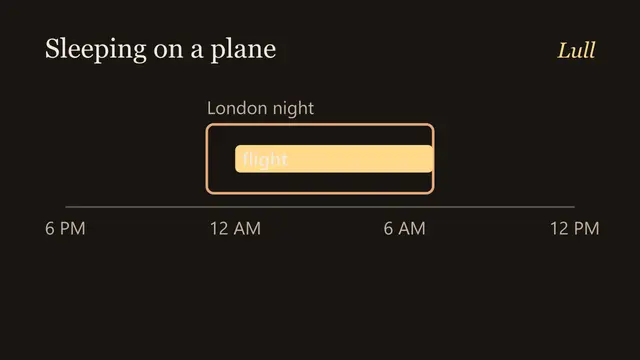
Night where you land? Sleep. Day there? Stay awake.
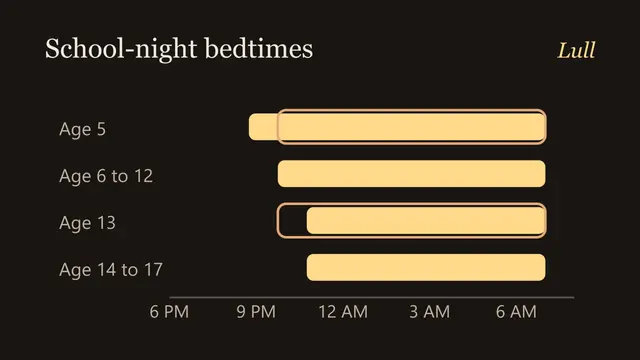
Latest lights-out for every school age, by wake-up time.
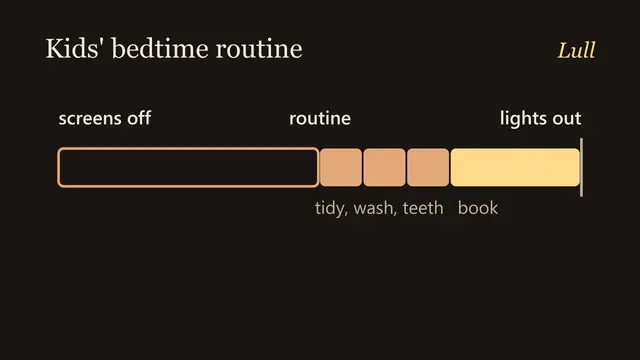
Screens off, tidy-up, teeth, book: timed to lights-out.
Sleep guidance is public. The NIH, the CDC and NIOSH publish it, free to read. Very little of it comes as the thing you need at bedtime: a time on the clock. Lull does that last step and shows its work, figure by figure.
Free, no sign-up · your answers stay in your browser · every figure listed with its source.
The site is free and carries ads, which never change a time. The app is free with one banner ad, and $1.99 once removes it.